
A business needs more than a good product or service to stand out in a competitive market. Customers should be able to recognize the business, understand what it offers, and identify why it is different from competitors. This is where branding becomes important.
Three concepts often influence how people understand a company: brand identity, brand image, and brand positioning. Although these terms are connected, they have different meanings and serve different purposes.
Understanding these differences helps startups, small businesses, and established companies build a consistent presence and communicate their value more effectively.
What Is Brand Identity?
Brand identity refers to the visual and verbal elements a business creates to represent itself. It communicates the company’s personality, values, and overall character through different brand assets.
These elements help customers recognise a business across websites, advertisements, packaging, and social media platforms.
Some important components include:
- Logo: The visual symbol associated with the business.
- Colour Palette: Colours used consistently across marketing materials.
- Typography: Fonts that reflect the brand’s communication style.
- Brand Voice: The language and tone used to communicate with customers.
- Visual Style: Photography, graphics, layouts, and other design elements.
For example, a premium skincare company may use minimal packaging, elegant typography, and a neutral colour palette to communicate simplicity and quality.
A well-developed identity should reflect the actual values and personality of the business rather than simply following design trends.
What Is Brand Image?
Brand image refers to how customers actually perceive a business. Unlike identity, which is created by the company, image develops through customer experiences, opinions, reviews, and interactions.
A business may want to be recognised as reliable and customer-focused, but its actual reputation depends on whether customers experience those qualities.
Several factors influence perception:
- Product and service quality.
- Customer support and communication.
- Online reviews and recommendations.
- Social media interactions.
- Advertising and public relations.
- Overall customer experience.
For example, a company may advertise itself as customer-friendly, but delayed responses and poor after-sales support can create a negative perception.
Businesses cannot completely control what customers think. However, they can influence perception through consistent service, honest communication, and reliable experiences.
What Is Brand Positioning?
Brand positioning defines how a company wants to be recognised in the minds of its target customers compared with competitors.
It focuses on the specific value a business offers and the reasons customers should choose it.
An effective positioning approach considers:
- Target audience and customer needs.
- Competitor strengths and weaknesses.
- Unique selling proposition (USP).
- Product or service benefits.
- Price, quality, and market category.
For example, two companies may sell similar fitness products. One may position itself around affordability, while the other focuses on premium quality and specialised performance.
Both businesses operate in the same industry, but their positioning communicates different reasons to purchase.
Clear positioning helps companies develop focused marketing messages and attract customers who value their offerings.
Brand Identity vs Brand Image vs Brand Positioning: Key Differences
Although these three concepts work together, their roles are different.
| Factor | Brand Identity | Brand Image | Brand Positioning |
| Meaning | How a business presents itself | How customers perceive it | How a business differentiates itself |
| Created by | The company | Customers and market experiences | The company, through strategic decisions |
| Main focus | Visual and verbal representation | Reputation and perception | Competitive differentiation |
| Key elements | Logo, colors, typography, voice | Reviews, experiences, trust | USP, audience, value proposition |
| Main objective | Recognition | Positive perception | A distinct market position |
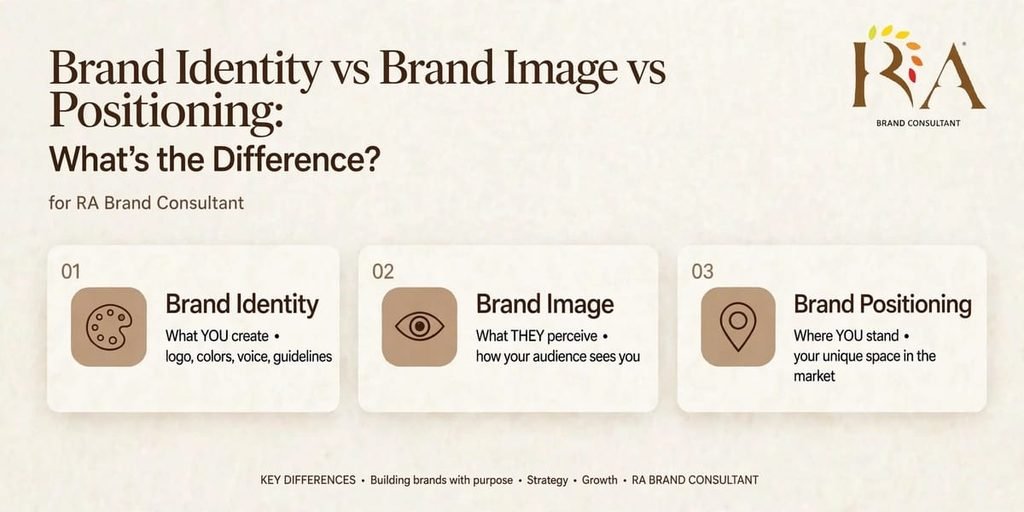
In simple terms, identity is what a company creates, image is what people think, and positioning is the place the company aims to occupy compared with competitors.
How Brand Management Connects These Three Concepts
Effective brand management helps maintain consistency between what a company communicates and what customers experience.
It involves planning, implementing, monitoring, and improving branding activities across different channels.
For example, if a business positions itself as a premium service provider, its website, customer support, pricing communication, and overall experience should reflect that promise.
Without proper coordination, the company may communicate different messages across platforms, creating confusion among customers.
A structured approach helps businesses:
- Maintain consistent communication.
- Monitor customer feedback and reputation.
- Strengthen brand recognition.
- Align marketing activities with business goals.
- Adapt to changing customer expectations.
Branding should not be treated as a one-time activity. It requires regular evaluation as the company, market, and customer expectations evolve.
Why Is Brand Identity Design Important for Businesses?
Professional brand identity design helps translate a company’s values and positioning into recognizable visual and verbal elements.
For startups, it establishes a professional foundation when entering the market. For established businesses, it can help improve consistency or support a rebranding project.
A well-designed identity can help businesses:
- Create a recognizable visual presence.
- Communicate their personality and values.
- Maintain consistency across marketing channels.
- Build familiarity with their target audience.
- Support a more professional customer experience.
However, good design alone cannot guarantee customer trust or business growth. The actual product, service quality, and customer experience must support the promises communicated through branding.
How Business Branding Brings Everything Together
Successful business branding requires coordination between identity, image, and positioning.
Consider a startup launching an organic food brand.
First, it develops a visual identity using natural colors, clear typography, and packaging that reflects its values.
Next, it positions itself around transparent sourcing and quality ingredients for health-conscious consumers.
Finally, customers develop an image of the company based on product quality, reviews, communication, and their overall buying experience.
If these elements support one another, the business can create a more consistent and credible market presence.
This example demonstrates why companies should consider branding as a complete business activity rather than focusing only on logos or promotional campaigns.
How RA BRAND CONSULTANT Can Help Build a Consistent Brand
RA BRAND CONSULTANT provides branding and digital marketing services to help businesses establish and strengthen their market presence.
Its services include brand strategy and management, identity development, website development, SEO, social media marketing, content creation, and performance marketing.
Depending on business requirements, the process can involve understanding the company’s audience, evaluating its market position, developing a consistent identity, and connecting branding activities with digital marketing channels.
For startups, this can mean creating a clear foundation before entering the market. For established businesses, it may involve improving existing communication and maintaining consistency across different customer touchpoints.
Businesses can explore RA BRAND CONSULTANT’s services to identify suitable branding and marketing solutions based on their objectives.
Conclusion
Brand identity, brand image, and brand positioning are three connected but different parts of successful branding.
Identity represents how a company presents itself, image reflects how customers perceive it, and positioning establishes how it wants to stand out from competitors.
Businesses that understand these differences can make more informed branding decisions and maintain consistent communication.
Whether launching a startup or improving an established company, combining thoughtful design, clear positioning, and positive customer experiences can help build a recognizable and credible business presence.
Frequently Asked Questions (FAQs)
1. What is the main difference between brand identity and brand image?
Brand identity is created by the company through its visual and verbal elements. Brand image develops through customer opinions, experiences, and interactions.
2. Is brand positioning the same as brand identity?
No. Positioning defines how a business wants to differentiate itself in the market, while identity represents the visual and verbal elements used to communicate its personality.
3. Why is brand identity important for startups?
It helps startups establish recognition, communicate their values, and create a consistent presence across marketing platforms.
4. What does brand management include?
It includes maintaining brand consistency, monitoring customer perception, managing communication, reviewing performance, and improving branding activities.
5. Can brand image change over time?
Yes. Customer experiences, product quality, reviews, public communication, and changes in business practices can influence how people perceive a company.
6. How can businesses improve their brand positioning?
Businesses should understand their target audience, research competitors, identify their genuine strengths, and communicate a clear value proposition consistently.